Always Be Interviewing: Why Talent Identification Should Be Continuous

Always Be Interviewing: Why Talent Identification Should Be Continuous
Something has changed with resumes over the last six to twelve months. They're getting better, or at least they're looking better.
AI has lifted the general standard considerably. Formatting is cleaner, grammar is better, project descriptions are more polished and people who historically struggled to articulate their experience can now put together a pretty professional-looking document. I'm not against that at all. If AI helps somebody present 15 years of genuinely good experience more clearly, brilliant.
The unintended consequence is that resumes are becoming increasingly uniform. Everybody is commercially astute, an excellent communicator, a collaborative team player, capable of working independently and apparently comfortable in every environment imaginable.
The rising tide has lifted all boats, but it's also made it slightly harder to work out which boats are actually any good.
For years, the resume itself could separate candidates to some degree. AI is gradually removing some of that distinction, which isn't necessarily a bad thing. But I do think it means employers need to become less reliant on the piece of paper, not more.
Be careful of the person you've already created in your head
Construction is particularly prone to having a preconceived idea of what the successful candidate needs to look like.
A Project Manager who's already built a $100m hospital. An Estimator from a Tier 2 builder. A CA who's completed three projects between $30m and $50m. Somebody who's already worked with this particular client or delivered this particular type of building.
There's normally perfectly good logic behind it. Construction is fundamentally a risk-management industry and that extends to recruitment. If somebody has already built exactly what you're about to build, for a similar client, at a similar value and ideally more than once, they appear to be a safer appointment.
The problem comes when "this person has done it before" turns into "anyone who hasn't done it before can't do it."

People learn, adapt and develop. Knowledge and skills transfer from one environment to another. Somebody working for a smaller builder may have carried considerably more responsibility than somebody with the same title at a Tier 1. Someone who hasn't built your exact project may have dealt with far greater complexity somewhere else.
Equally, you can find somebody who's built five hospitals who isn't particularly good.
Experience and capability are related, but they're not the same thing.
I suspect some of the reluctance to look outside the perfect profile comes down to training and development. At junior level we're comfortable with it. A Graduate CA isn't expected to know everything and we accept that we're going to invest time into them because they're learning and their salary reflects that.
Once somebody is earning $150k, $180k or $220k, our expectations change. At that money, they should know what they're doing.
Fair enough. But there's a difference between needing somebody to be taught how to do their job and somebody needing time to understand how your business does that job.
We'll train the AI.....but apparently the humans should already know everything
I was talking to a Commercial Manager recently who was building an AI agent to help review contracts and extract information. He'd been spending an hour or two some evenings working on it and reckoned he'd probably invested somewhere around 15 to 20 hours over the previous month training, testing and improving the system.
So I asked him whether his own staff had received 15 or 20 hours of training that month.
No, not really. They should know what they're doing.
I thought that was quite interesting.

We're perfectly comfortable accepting that an AI system needs to be trained, corrected, tested and continually improved before it performs the way we want. Yet sometimes we'll employ a human being and expect them to arrive on Monday morning as the finished article.
People are appreciating assets if you get the right ones. Knowledge can be taught, systems can be learned and project experience accumulates. The harder things to teach are often the characteristics that ultimately determine how far somebody develops:
- Drive and curiosity
- Self-awareness and emotional intelligence
- Work ethic and reliability
- The ability to build trust and relationships
- A genuine desire to improve
- The inclination towards mastery rather than simply doing enough
Unfortunately, none of those things fit particularly neatly into a resume.
You normally have to meet the person.
If you're not sure, call them
One of the earliest things I was taught in recruitment, probably somewhere around 2005, was incredibly simple: if you look at a resume and you're not sure, call them.
I still do it today.
There are candidates I can look at and fairly confidently rule in, and others I can reasonably rule out. It's the ones in the middle that are interesting. Maybe the experience isn't quite right, the companies aren't what I expected, there's an unusual career move or they've worked on slightly different projects.
Something doesn't quite fit, but there's enough there to make me wonder.
Within 15 or 20 minutes on the phone you can learn a lot. Can they explain what they've actually done? Do they listen? Are they credible and engaging? Do they understand their own strengths and weaknesses? Do they sound like somebody who could walk into a room full of consultants, subcontractors or clients and hold their own?

Sometimes that conversation confirms exactly what you suspected from the CV. Fine. You've lost 20 minutes.
Sometimes it completely changes your opinion.
I've seen employers reject candidates on paper who subsequently join competitors and go on to perform brilliantly. Nobody really goes back two years later and asks: what did that business see in them that we didn't?
Perhaps they got lucky. Or perhaps they interviewed the human being rather than the employment history and identified intelligence, adaptability, ambition or leadership potential that wasn't particularly obvious from the CV.
Martin's Tip: If you're on the fence about somebody, a 20-minute phone call is a pretty inexpensive way of finding out whether your initial assumption was right.
If a recruiter you trust sends you an unusual CV, ask them why
This is where the relationship between employer and recruiter becomes particularly important.
If an experienced recruiter who knows your business presents somebody and you look at the CV and think, I'm not sure about this one, before immediately rejecting them, ask the recruiter why they sent them.
There's a reasonable chance the recruiter thought exactly the same thing when they first saw the resume.

Perhaps they spent 20 minutes screening them and something interested them. So they invested another hour interviewing them, questioned their project experience, reasons for leaving, salary, ambitions and motivations and, after all of that, still decided: I think you should meet this person.
You don't have to agree with them and the recruiter won't always be right. But if you've selected somebody because you trust their judgement and knowledge of your market, I'd at least be curious about what they've seen that you haven't.
Otherwise, you're effectively paying somebody for their judgement and then ignoring that judgement because the resume doesn't look exactly how you imagined it would.
Martin's Tip: When a trusted recruiter sends you somebody unexpected, don't only ask, "Why doesn't this person fit my brief?" Ask, "What have you seen in them that isn't obvious on the CV?"
I watched this happen with an HSE Manager
A while ago I was recruiting an HSE Manager for a commercial builder. I presented somebody who I thought was worth meeting. They were towards the upper end of the salary range and didn't have quite the depth of experience the employer originally envisaged, so the client had some perfectly reasonable reservations.
Then came the questions. What exposure did they have to ISO-accredited systems? Had they developed safety management systems or primarily maintained them? How had they supported Site Managers and delivery teams implementing those systems?
All good questions.
Except instead of interviewing the candidate and asking them directly, the process became employer to me, me to candidate, candidate back to me, me back to employer. Then another question would come through and we'd go around again.
The candidate had initially been genuinely interested in the business. Eventually, they lost interest.

They then interviewed with another builder and were offered a national HSE management position.
When I told my client, they were surprised. They hadn't expected that candidate to step directly into a national role.
And that's the point. They could have discovered whatever the other employer discovered for the cost of about 45 minutes.
Sit down with them. Ask the questions yourself. Challenge them. See how they respond.
Particularly in something like HSE, technical knowledge is only part of the job. You need to persuade people, influence them, gain buy-in, build trust and occasionally convince a Site Manager who's been building for 30 years that there's a better or safer way of doing something.
You can't properly assess that by emailing questions through a recruiter.
Talent identification should be continuous
This is probably the bigger point behind all of this.
I'm not suggesting every Construction Manager needs to spend half their week drinking coffee with random candidates, nor should businesses constantly interview people for jobs that don't exist.
But good businesses should have a more continuous approach to talent identification.
If somebody interesting appears and you're on the fence, have a 20-minute call. If that goes well, have a coffee. If your recruiter meets somebody genuinely impressive who could potentially add value in six or twelve months, meet them.
You don't necessarily need a live vacancy.
One or two conversations a week isn't an enormous commitment. Some weeks there won't be anybody worth meeting. Over a year, however, you develop a pretty useful understanding of what talent actually exists in your market.
You also:
- Improve your own interviewing and assessment skills.
- Understand market salaries and expectations.
- Learn what competitors are offering and how they're perceived.
- Hear why people might or might not consider your business.
- Build relationships with potential future employees before you desperately need them.
- Challenge your own preconceived ideas about what a successful candidate needs to look like.

Most importantly, you develop a much better understanding of what good actually looks like in the current market, rather than what you think it should look like based on the last person you employed.
Compare that with what happens in plenty of businesses. Nobody recruits for six months, a Senior Estimator suddenly resigns and now there's pressure.
"We need a Senior Estimator. $250k. Ideally somebody who's worked for X, Y or Z, knows our sectors, can lead the team and we'd like them reasonably quickly."
Then comes the phone call to the recruiter:
"Who have you got on your books?"
I had a version of that call recently. A Senior Estimator vacancy paying around $250k, with another recruiter who had already been looking for approximately a month.
Senior Estimators don't grow on trees. If they did, I'd have planted several acres of them years ago.
The problem isn't necessarily that the right person doesn't exist. The problem is that the business has only started thinking about who the right person might be once the vacancy has become urgent.
Urgency changes recruitment. Your candidate pool gets smaller because you need somebody now, you're more likely to compromise because a project needs resources, and suddenly availability starts carrying more weight than it probably should.
That's recruitment risk.
Think like an elite sporting team
Pick your favourite elite sporting club. Do you think they only start looking at players the day somebody retires, gets injured or announces they're leaving?
Of course not.
They're constantly assessing talent. Who's developing? Who's unhappy? Who's coming out of contract? Who's performing exceptionally well in a weaker team? Who has attributes that could transfer? What capability will the team need next?
They're not signing everybody they watch. They're simply always watching.
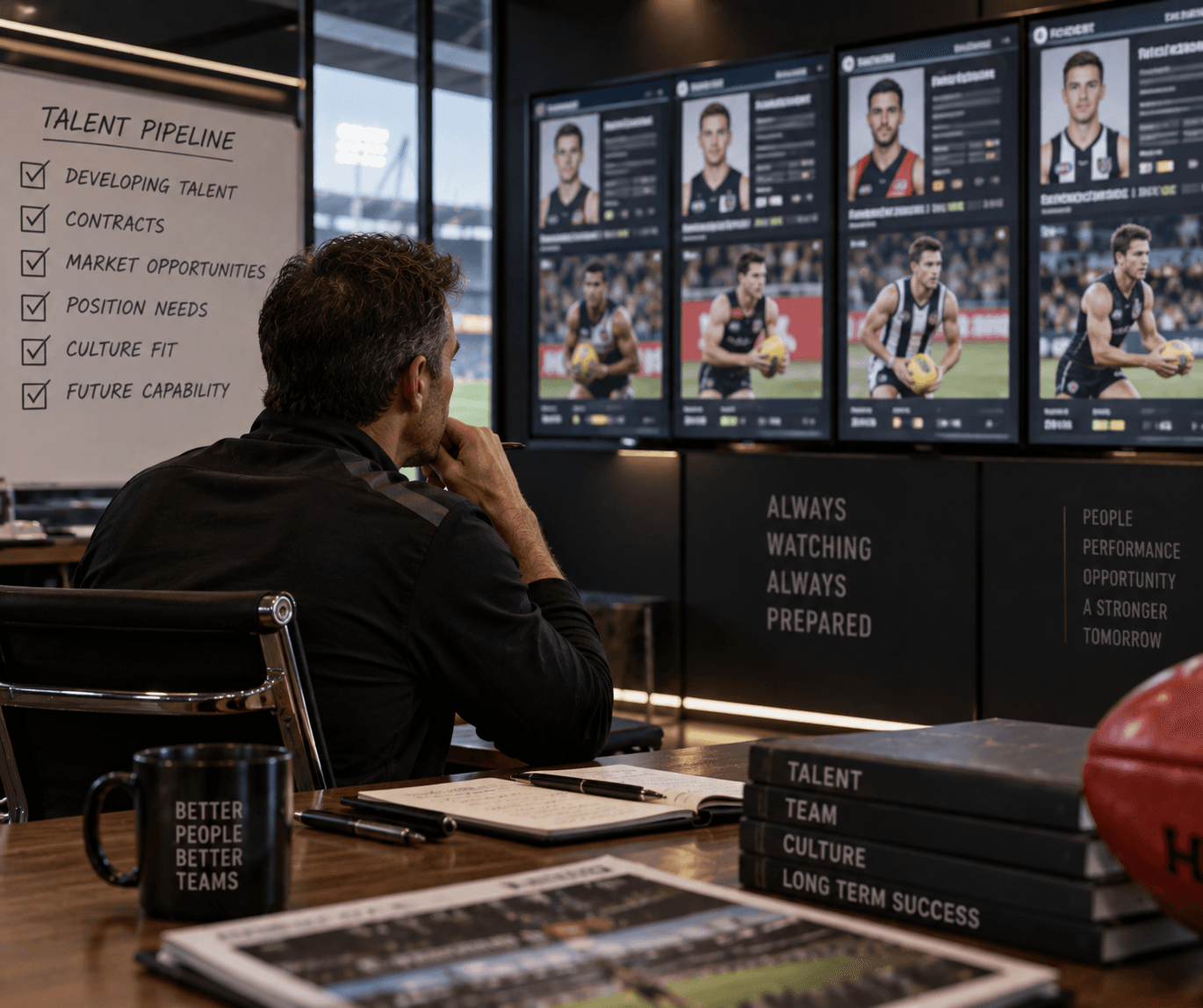
Commercial builders are elite businesses too. If you're delivering $50m, $100m or $500m projects, the quality of the people making thousands of decisions throughout those projects matters enormously.
So why wouldn't talent identification be continuous?
That doesn't mean endlessly advertising vacancies or interviewing five people every Friday afternoon. It means keeping your finger on the pulse. Use recruiters who genuinely know the market and listen to what they're seeing. Meet interesting people occasionally. Keep relationships warm and know who you'd be interested in if circumstances changed.
Then, when your PM quits, your Site Manager goes on long service leave, your CA decides to travel or your Estimator gets headhunted by the bigger fish down the road, you're not starting from zero.
The resume should start the conversation, not finish it
As AI gets better, resumes will probably become even more polished and increasingly similar.
That's fine. But I think that makes human judgement more important, not less.
A CV can tell you where somebody worked, what projects they were involved in, how long they stayed and what responsibilities they're claiming. It can't reliably tell you how quickly they'll learn, whether people will follow them, whether they'll improve the people around them, whether they take ownership when things go wrong or whether they've got another level in them that their current employer hasn't managed to unlock.
You discover those things by talking to people.
So perhaps the recruitment question shouldn't always be:
"Does this person look exactly like who we thought we wanted?"
Sometimes the better question is:
"Is there enough here that it's worth 20 minutes to find out who they actually are?"
Because we spend an awful lot of time in recruitment talking about the risk of engaging the wrong person.
There's another recruitment risk that gets considerably less attention.
Never meeting the right person in the first place.
And the worst part is, you might only discover they were the right person two years later, when they're performing brilliantly for your competitor.