Getting the Best Out of 2026: A Practical Career Plan for Professionals within the Built Environment

Getting the Best Out of 2026: A Practical Career Plan for Professionals within the Built Environment
Every January, the same conversations start floating around sites, offices, and LinkedIn:
“Big year this year.”
“Time to step things up.”
“Thinking I might make a move.”
All good intentions, and most of them go nowhere.
Not because people are lazy. Not because they lack ability. But because careers are rarely planned with the same rigour that we apply to projects. Heaps of folk plan projects to the nth degree yet somehow expect our careers to simply work themselves out.
If 2026 is going to be different, it won’t be because of a vague resolution. It’ll be because you made deliberate decisions, took a few uncomfortable steps, and stacked small wins consistently.
Forget New Year’s Resolutions……Build a Career Plan
Most resolutions sound good but mean very little:
“Get promoted.”
“Earn more.”
“Find a better company.”

These are outcomes, not plans.
In our industry, you’d never accept a project brief that says, “Build something good, make money, finish sometime this year.” Yet that’s exactly how many people approach their careers. A real career plan doesn’t need to be fancy. It just needs clarity around four things:
- Where you are now
- Where you want to go
- What’s realistically in the way
- What you’re going to do about it
Hope is not a strategy. Neither is blaming the market, your boss, or the industry.
Treat Your Career Like a Live Project
A simple mindset shift transforms everything:
Treat your career like a project you’re responsible for delivering.
Think about it in familiar terms:
- Your current role = existing conditions
- Your next role or level = the finished product
- Skill gaps = defects
- Experience, feedback, learning = remedial works

Here are four quarterly review questions every construction professional should ask:
- What’s actually working well right now?
- What am I avoiding because it’s uncomfortable?
- Where do I keep getting the same feedback?
- What skills do the people one or two levels up clearly have that I don’t (yet)?
As George Abraham (Managing Director, Hickory) shared on The Building Talks Podcast:
Reflect without attaching emotion. Don’t take it personally. Don’t dismiss it. Learn from it.
That mindset alone separates the people who progress from the people who stall.
Small Wins Beat Big Promises, Every Time
High performers don’t make giant leaps….they stack small wins.
In construction and property, small wins look like:
- Running a site meeting more confidently
- Handling a difficult subcontractor better than last time
- Understanding the commercial impact of a variation, not just the scope
- Speaking up earlier when something doesn’t feel right
You don’t need to overhaul your entire career in 2026. You just need one or two areas where a 5–10% improvement will make a real difference.
Stack those improvements across an entire year and your trajectory changes quickly.

Identify the Real Skill Gaps (Not the Popular Ones)
This is where honesty matters. People often think they need:
- Another qualification - A better CV & a new job - More confidence
But the gaps that actually hold people back are usually far less glamorous:
- Poor communication under pressure
- Weak stakeholder management
- Avoiding difficult conversations
- Limited commercial understanding
- Inability to clearly articulate value — especially in interviews
When Sean Ryan (Managing Director, Delatite Projects) said when he came on The Building Talks podcast outlined:
Step into situations before you feel ready; that’s where the real gaps reveal themselves.
If you're unsure what your gaps are, ask someone a level or two ahead of you. Just be prepared to actually listen.
SMART Goals, Without the Corporate Nonsense
SMART goals get mocked because they’re usually taught terribly. Used properly, they simply turn vague intentions into clear actions.
Instead of:
“Get better at leadership.”
Try:
“By June 2026, I will lead site meetings independently, seek feedback from my PM after each one, and implement one improvement each month.”
Instead of: “Move into development.”
Try: “In 2026, I will spend one hour a week learning feasibilities, sit in on at least three, and speak with two people currently working in development.”
The point isn’t the acronym. The point is clarity. Clarity makes action easier.

Instead of:
“Move into development.”
Try:
“In 2026, I will spend one hour a week learning feasibilities, sit in on at least three, and speak with two people currently working in development.”
The point isn’t the acronym. The point is clarity. Clarity makes action easier.
Different Stages, Different Focus
Early Career - Your focus here is speed of learning and exposure.
- Get involved in as many parts of a project as possible
- Ask why something is done, not just how
- Build a reputation for reliability and effort
Your goal isn’t comfort. Your goal should be competence (and mastery), quickly without fuss.

Mid Level - This is where many careers plateau.
You’re technically capable, but progression now relies on:
- Communication
- Commercial awareness
- Leadership behaviours
This is the stage where managing upwards, understanding business drivers, and owning outcomes separates the climbers from the cruisers.
Senior Level - At senior level, technical skill is assumed.
Your impact is measured by
- The people you develop
- The decisions you make under pressure
- The outcomes you deliver consistently, for the team and business
Your 2026 focus may be refining judgment, mentoring others, or stepping deeper into strategic responsibility.
If You’re a Hiring Manager, Your Career Is Other People
For hiring managers, leaders, and business owners, 2026 shouldn’t just be about your own progression. It should be about how effectively you elevate others.
One of the biggest misconceptions in construction and property is that good technical people automatically become good managers. They don’t.

Management is its own trade.
Important questions to ask yourself:
- Do my people know what “good” looks like?
- Do I give clear feedback, or avoid it until something goes wrong?
- Am I developing capability or just pushing for output? (Am I improving people in the team?)
- Would people actively choose to work with me again?
Strong leadership delivers stronger projects, and this theme comes up constantly with senior leaders on The Building Talks Pod. The best project outcomes are almost always tied to managers who invest time in people, not just programmes and spreadsheets. It’s that simple.
Setting Better Management Goals
Instead of vague intentions like “be a better leader,” hiring managers can set practical, measurable goals, for example:
- By mid-2026, I will hold structured monthly one-on-ones with each direct report, focused on development, not just tasks
- I will give timely feedback after key milestones, not six months later in a performance review
- I will identify one stretch opportunity for each team member this year and support them through it
These aren’t soft goals. They directly impact productivity, retention, and project outcomes. Richard Austin (CEO, Omnii) has spoken on the podcast about planning and motivation being inseparable, teams perform best when people understand the plan, see how their role fits into it, and are aligned around clear priorities. Motivation drops quickly when direction is vague, goals keep shifting, or people don’t understand why decisions are being made.
From a practical management perspective, that means:
- Setting a clear plan and sticking to it unless there’s a genuine reason to change
- Making sure each team member understands how their work contributes to the wider outcome
- Aligning individual goals with project milestones, not treating them as separate conversations
When people are aligned to the plan, motivation becomes a by-product rather than something managers have to constantly manufacture.
Improving Others Improves Everything
Strong managers understand a simple truth, when your people improve (or when you can access, attract, and hire better people – if you need a good recruiter to help with this, reach out!), projects improve.

Better communication reduces rework. Clear expectations reduce conflict. Developing future leaders reduces risk.
If 2026 is going to be a better year for your business or projects, investing in your management capability is one of the highest return activities available. The market is tight, good people have options, and average leadership gets found out quickly.
Build Review Points, Because No One Else Will
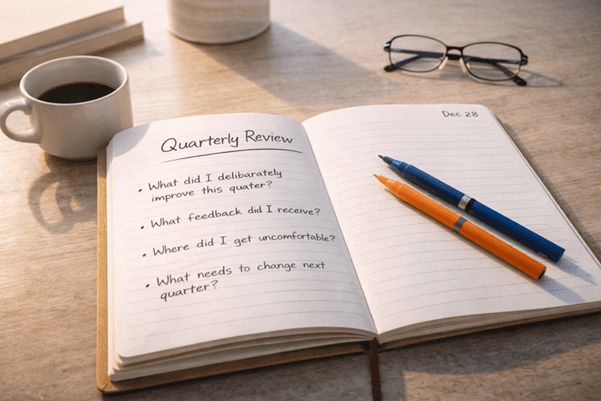
Most professionals only reflect when something goes wrong. A simple quarterly review can change your year:
- What did I deliberately improve this quarter?
- What feedback did I receive?
- Where did I get uncomfortable?
- What needs to change next quarter?
If December arrives and you can’t name what you improved, that’s insight.
Comfort Is the Quiet Career Killer
Comfort looks harmless but it’s expensive. It shows up as:
- Staying quiet in meetings
- Avoiding accountability
- Waiting to be noticed
- Doing just enough

Growth feels awkward first. So does every promotion, every new responsibility, every stretch opportunity.
As I’ve said before (I didn’t say it originally, someone else did – I just use it a lot):
Life begins on the other side of your comfort zone….careers do too.
A (nearly) Final Thought for 2026
The people who progress in construction and/or property, often aren’t the most talented on paper. They’re the ones who reflect honestly, take responsibility, and act deliberately.
2026 will reward the intentional, not the hopeful.
Employees need to own their growth. Managers need to own their impact.
When both happen, careers accelerate, teams strengthen, and projects get delivered properly.
A Final Note
I spend my days speaking with construction and property professionals at every level - from graduates finding their feet to senior leaders building teams and businesses. Through my recruitment work and The Building Talks Podcast, I get a front row seat to what helps people progress, and what quietly holds them back.
If you want straight talking insights on careers, hiring, leadership, and what’s really happening in the market, feel free to follow or connect here on LinkedIn.
No fluff - just practical, industry specific advice to help you get the most out of 2026.